
Why Perfectionism Isn’t a Virtue: How “The Refiner” Safeguard Is Quietly Sabotaging Your Career
Perfectionism Isn’t High Standards — It’s a Safeguard and Here’s How It Works
Quick Answer: Perfectionism isn’t a personality trait or a sign of high standards — it’s a Safeguard called the Refiner. The Refiner Safeguard protects self-acceptance through the quality of your work, convincing you that flawless output is the only safe output. Left unexamined, it drives over-editing, missed deadlines, and chronic exhaustion — and it often shows up alongside another Safeguard, the Qualifier, which seeks approval through external validation instead.
“Perfectionism” Is the Wrong Word for What’s Actually Happening
Perfectionism gets celebrated in professional culture. It shows up on resumes as “attention to detail” and in performance reviews as “high standards.” Most people wear it like a badge — proof that they care, that they take their work seriously, that they’re reliable.
But if you’ve ever stayed two extra hours rewriting a paragraph no one was going to scrutinize, or felt a flash of dread the moment something left your hands and entered someone else’s, you already know that perfectionism doesn’t feel like a virtue from the inside. It feels like pressure that never fully lets up.
That’s because it isn’t a virtue. It’s a Safeguard — a reactive pattern your mind built to protect you from a deeper fear. In this framework, that Safeguard has a name: the Refiner.
Meet the Refiner Safeguard: What It Sounds Like in Real Life
The Refiner Safeguard doesn’t announce itself as fear. It shows up as diligence. Common signs include:
• Revising work long after it has met the actual requirement
• Difficulty calling something “done,” even under deadline pressure
• A disproportionate reaction to small mistakes — a typo, a missed detail — that lingers far longer than the error warrants
• Measuring your own work against the best version of someone else’s, rather than against the actual goal
If this sounds familiar, the Refiner Safeguard isn’t making you better at your job.
It’s making your job harder than it needs to be — and convincing you that the difficulty is the price of competence.
The Limiting Core Belief Behind the Refiner Safeguard
Every Safeguard exists as a reaction to a limiting core belief
— a deeply held, often unconscious narrative about what makes you good at your job or in relationships, acceptable, or worthy. For the Refiner, that belief usually sounds something like:
“If my work isn’t perfect, it will prove I’m not actually good enough.”
Notice what this belief is actually about. It isn’t about the work itself
— it’s about what the work is being used to prove.
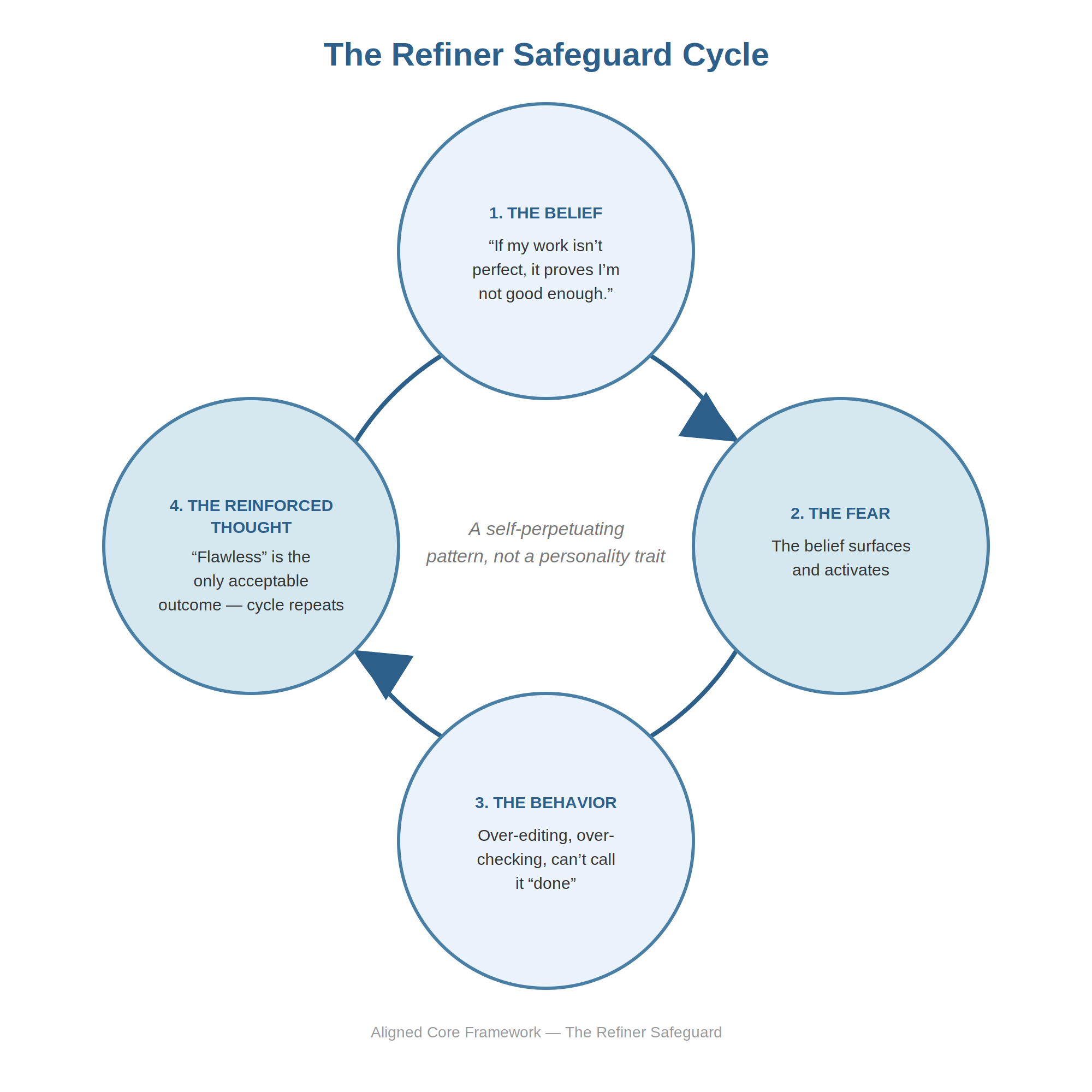
This is the Cycle
Make it stand out
The Refiner Safeguard ties your sense of self-acceptance directly to the quality of your output.
As long as the work is flawless, the belief stays hidden and you feel safe and outwardly accomplished.
The moment something falls short, the belief surfaces, and the Refiner kicks into action unconsciously reinforcing the belief system
— which usually means more revising, more checking, more hours.the belief creates the fear, the fear activates the behavior, and the behavior reinforces the thought that “flawless” feel like the only acceptable outcome. Nothing about this cycle resolves the original belief. It just keeps it running.
Thought: If I send this without checking it one more time, they’ll see I’m not as capable or knowledgeable as they think I should be.
Reaction: You rewrite the email for the fourth time and miss the window to send it before the meeting. Then you realize: “Dang, I did it again — now I have to explain to the team why I didn’t have my information ready.”
Result: You look like you are unprepared and uncertain which does not convey leadership potential.
What the Refiner Safeguard Is Costing You
The Refiner Safeguard costs tend to show up in places that are easy to miss day-to-day, but add up fast:
• Time spent perfecting work well past the point of diminishing returns (No tangible return on investment of time and energy)
• Missed visibility moments — the idea you didn’t share because it wasn’t “ready enough” to pitch; the project you didn’t volunteer for because you weren’t certain you’d execute it flawlessly so someone else got the visibility.
• Slower timelines that can quietly shape how others view your reliability as a business partner or team member, regardless of the quality of the final product
• Burnout that accumulates from operating at a standard no role actually requires but you keep giving.
None of this is a motivation problem. It’s the predictable result of a belief to thought to reaction pattern that continues to play out unchecked.
Inside the Pattern Are Hidden Strengths
There are parts of this pattern that are helpful. None of this means the underlying trait is the problem.
Care, precision, and high craft standards are genuinely valuable
— they’re part of what makes strong work strong.
The goal isn’t to lower your standards or stop caring about quality.
It’s to separate the standard from the fear underneath it, so the same attention to detail can operate as an asset and not a barrier to your success.
Why Perfectionism Often Travels With Imposter Syndrome
The Refiner Safeguard rarely operates alone. It frequently shows up alongside another Safeguard — the Qualifier — which is the pattern most commonly recognized as imposter syndrome.
Both Safeguards are solving the same underlying problem — earning a sense of approval and self-acceptance — but through different routes.
The Refiner Safeguard’s sounds like: “If the work is flawless, I’m proving myself.”
The Qualifier Safeguard sounds like: “If someone else confirms I’m good, it proves I do belong here.”
One looks inward to the work itself for validation; the other looks outward for validation.
If you recognize both patterns in yourself — obsessively refining work and also needing reassurance that it landed well — that’s not a contradiction. It’s a sign that more than one Safeguard is active, each reinforcing the belief that you have to earn your acceptance rather than already having it.
If the Qualifier pattern sounds familiar, it’s worth reading more about how that Safeguard shows up and what it’s protecting. Qualifier/Imposter Syndrome Blog
Moving From Refining to Releasing: Where Change Actually Starts
Most advice aimed at perfectionism targets the behavior directly: set a timer, lower the bar, just ship it.
These tactics can help in the moment, but they rarely last, because they don’t touch the belief generating the behavior in the first place. As soon as the stakes rise again, the Refiner Safeguard behaviors come right back.
Lasting change starts by identifying the specific belief the Safeguard is protecting — and examining whether it’s actually true. That’s belief-level work, which needs to be done before behavior-level work, and it’s the difference between temporarily managing perfectionism and no longer needing it.
Ready to Find Your Own Safeguard Pattern?
If any of this resonates, the first step is identifying your own personal Safeguard system — the specific reactive patterns keeping you from stepping fully into the career you’ve worked for.
Take the Safeguard Profile Scan to learn more about your personal safeguard system and what it’s costing you — and protecting you from.
Frequently Asked Questions
Is perfectionism a sign of quality work?
Not necessarily. Quality work is the result of skill and good judgment about when something is finished.
Perfectionism, by contrast, is driven by fear of what an imperfect result might mean about your worth — which is why it often produces diminishing returns rather than better outcomes.
Why do high achievers struggle with perfectionism?
High achievers are often praised early in life for flawless results, which can tie their sense of self-acceptance and approval for consistently perfect output.
Over time, that connection becomes a Safeguard — a pattern that protects against the fear of falling short, even when the standard being chased exceeds what the situation actually requires.
How do I stop being a perfectionist at work?
Behavioral fixes like timers or deadlines can help temporarily, but lasting change requires identifying the core belief driving the perfectionism — typically a fear that imperfect work exposes inadequacy — and addressing that belief directly rather than only managing the behavior. When you feel the drive to perfect something ask your why? What is this thought based on? Where does it come from?
What’s the difference between perfectionism and high standards?
High standards are goal-driven: they’re about producing strong work for its own sake.
Perfectionism is fear-driven: it’s about avoiding the discomfort of being seen as anything less than flawless.
The same output can come from either place, but only one of them is sustainable.
Can coaching help with perfectionism?
Yes, particularly coaching models that address the core belief behind the behavior rather than only the behavior itself. Identifying why the perfectionism started and what it is protecting against is typically the starting point for change that holds up under pressure, not just in low-stakes moments.
Katherine Flechaus, LCSW, is a Licensed Clinical Social Worker, Life Coach, and Core Belief Strategist, and founder of Aligned Core Life Coaching. With more than 30 years of experience at the intersection of behavioral health and leadership development, she works with ambitious, high-achieving women to identify the protective belief patterns quietly limiting their confidence, visibility, and authority — and redirect them. Her proprietary Aligned Core Framework works at the level where patterns actually change.